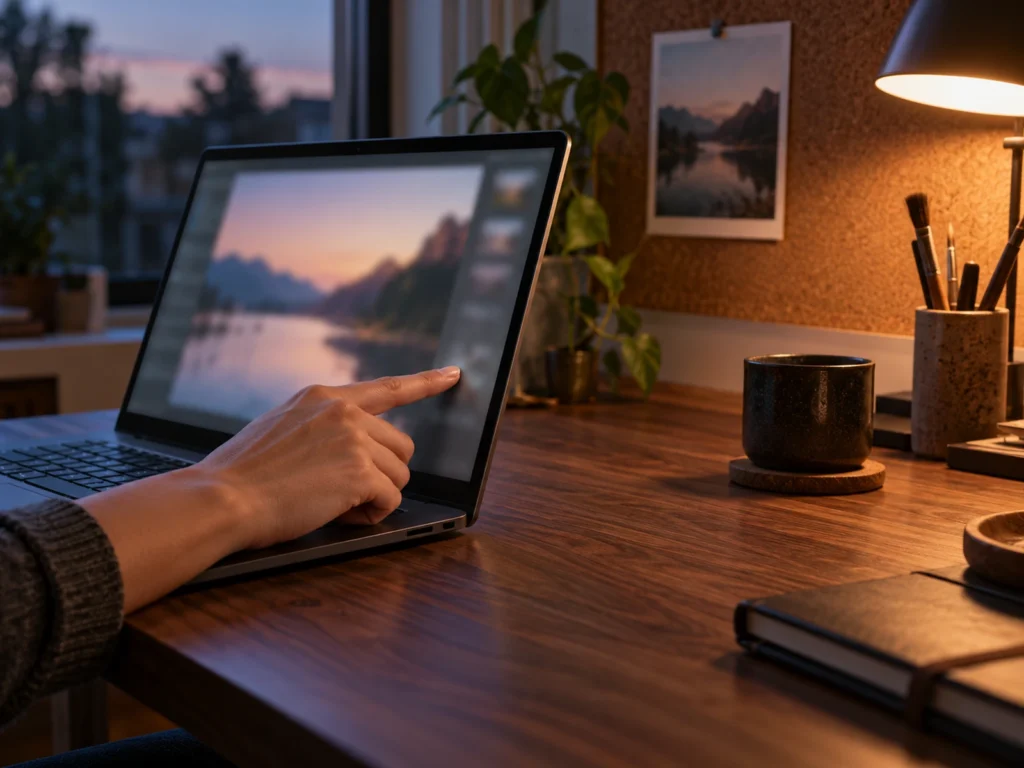
If you were about to order the 14-inch MacBook Pro with M6, Apple now sells a second 14-inch Pro beside it, with an OLED touch screen, for $900 more. This OLED MacBook Pro, sold as the MacBook Pro with PROLED XDR Display, runs M5 Pro and M5 Max chips rather than M6. Pre-orders opened on October 28, and the first machines arrive on November 6.
Apple’s starting prices in the US:
- 14-inch with M5 Pro: $2,899
- 16-inch with M5 Pro: $3,399
- 14-inch with M5 Max: $4,499
- 16-inch with M5 Max: $4,799
Best Buy lists the 14-inch M5 Pro version at the same $2,899, as a pre-order with a November 6 release date. That listing comes with 24 GB of memory and 1 TB of storage.
What the extra $900 buys
Apple rates the new panel at 2,000 nits peak brightness in everyday SDR work as well as HDR, thanks to two light-emitting layers in every pixel (Apple’s tandem OLED). The M6 model keeps mini-LED, rated at 1,600 nits for HDR. For photographers, the OLED panel also covers Adobe RGB on top of P3, the wider color space used for print work.
Touch comes to a Mac for the first time, through a sensor built into the panel. Older apps work on day one, because macOS turns a tap into a click. The iPhone’s Dynamic Island moves to the top of the screen as the home for Spotlight, Live Activities and Siri AI. A footnote adds that Spotlight moves there only with Siri AI turned on, and Siri AI is still a beta in macOS 27.2.
Apple puts the 14-inch at 3 pounds, half a pound less than before. The 16-inch drops to 4 pounds, 0.7 pounds lighter than the mini-LED 16-inch with M5 Pro. Ports move up to Thunderbolt 5, and the M5 Pro version drives three external displays, one more than the M6 model.
The chips stay where they were
Apple’s release says the new cooling design keeps “the same” sustained performance of M5 Pro and M5 Max in the lighter body. Those are the chips Apple already sold in the mini-LED MacBook Pro. If you own one, the new model gives you a better screen, touch and less weight, and no extra speed. We’d skip it unless your work needs touch or Adobe RGB.
The cheaper 14-inch moved to M6 a day earlier. Apple compares M6 only with the plain M5, rating it up to 30 percent faster in graphics, so its own figures don’t show how M6 does next to M5 Pro. Buy the OLED model for the screen, then, and not as the faster laptop.
Touch apps arrive in stages
Apple names Word, Lightroom, DaVinci Resolve and Blender among the third-party apps that will be built for touch. A footnote says those apps “will be available later this year,” so don’t count on touch versions of them when the laptop arrives.
The touch keyboard Apple shows in Logic Pro, and the touch editing in Final Cut Pro, arrive as Apple Creator Studio updates in November. Creator Studio is a subscription. A new Mac includes three free months, and after that new subscribers pay $12.99 a month.
Living with an OLED screen
OLED pixels age with use. Apple says its display engine “monitors and adapts each pixel’s usage over time” to preserve image quality. We have no independent measurement of how this panel holds up. If a timeline or a toolbar sits on your screen all day, price AppleCare+ in with the laptop.
Our take
For most buyers, the $1,999 M6 model is the better buy. It has the newer chip, its mini-LED panel already handles HDR video well, and the money saved pays for more memory or storage. The OLED MacBook Pro earns its price for photographers and colorists who edit away from a desk and need Adobe RGB in the laptop itself. Everyone else can let the first buyers and the touch app updates arrive before deciding.