Samsung’s charging claim for the Galaxy S26 FE is a percentage after about 30 minutes on its 45 W adapter, and Samsung’s own documents don’t agree on the number. Its US newsroom release says up to 69 percent in the text and up to 65 percent in the spec list, and the Nordic press-kit spec sheet says 69 percent. None of them gives the test conditions, so read it as Samsung’s lab result with its own adapter, not a promise for every charge. Galaxy S26 FE charging depends on three things that Samsung splits across the small print. Those are the battery’s real capacity, the shape of the charging curve, and whether you own the right adapter and cable. Here is what each one means in practice, and what you should buy.
The numbers Samsung publishes
The FE carries a 4,900 mAh battery, and Samsung qualifies that figure carefully. The 4,900 mAh is a typical value, measured under third-party laboratory conditions and defined as the estimated average across battery samples tested to the IEC 61960 standard. The rated minimum capacity is 4,755 mAh. So the guaranteed floor sits about 145 mAh below the headline, a gap of roughly three percent.
Wired charging tops out at 45 W. Wireless charging runs at up to 15 W on a compatible Qi pad, and Wireless PowerShare lets the phone feed a watch or a set of earbuds from its own cell. Samsung notes that PowerShare may not work once the phone itself drops below 30 percent, so treat it as an emergency top-up rather than a charging method.
Why the claim stops at about two thirds
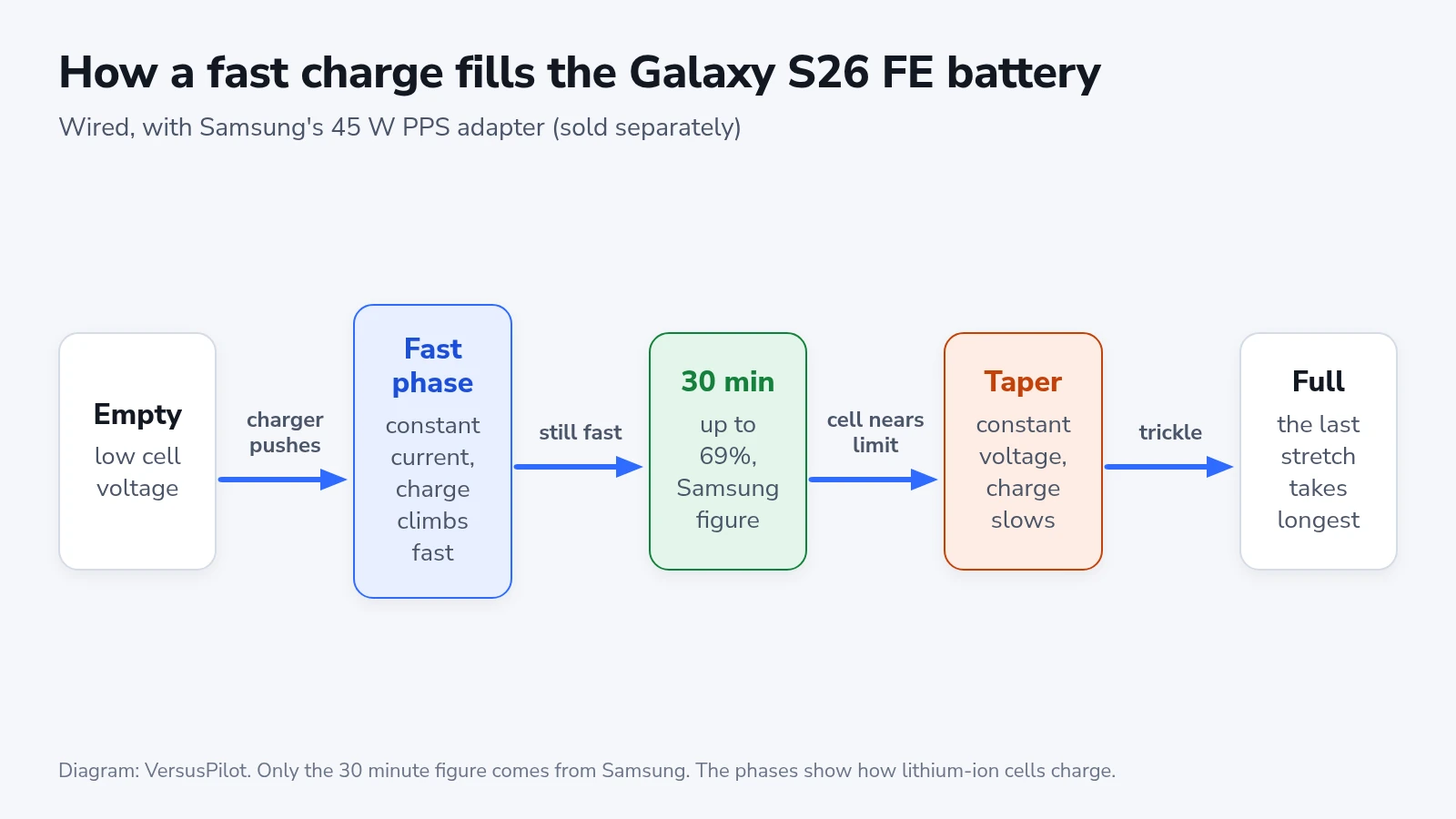
Lithium-ion cells do not charge at one steady rate. A charger pushes close to maximum current while the cell voltage is still low, which is the constant current phase, and the percentage climbs quickly. Once the cell nears its full voltage, the charger holds that voltage steady and lets current fall away. That is the constant voltage phase, and it is slow by design. Samsung adds that if the phone gets too hot, charging may slow down or stop for a while.
A 30-minute window therefore lands in the fast part of a typical curve, before the taper. Samsung doesn’t publish the S26 FE’s own charging curve, so this describes how lithium-ion charging generally works, not a measurement of this phone. It also explains why 45 W doesn’t mean a full battery in half an hour: the wattage is a peak, not an average.
Typical capacity against rated capacity
The two capacity figures matter more than they look. Manufacturing tolerance means no two cells hold exactly the same charge, so IEC 61960 testing produces a spread rather than a single value. Samsung publishes the average as the typical figure and the floor as the rated minimum. Your specific phone sits somewhere between them.
That spread is one reason two careful reviewers can measure slightly different screen-on times for the same model. It also means a battery health app reporting slightly under 4,900 mAh on a new phone is not necessarily showing a fault.
The adapter is sold separately, and that is now the norm
Samsung states plainly that the 45 W power adapter is sold separately. This is not a quirk of one brand. European Union common charger rules have applied to phones, tablets, digital cameras, headphones, earbuds, portable speakers, handheld game consoles, e-readers, keyboards, mice and portable navigation devices since December 28, 2024, and to laptops since April 28, 2026. They require a USB-C port, they require USB Power Delivery for fast charging, and they require manufacturers to let you buy a device without a charger at all.
The rules also changed the box itself. Packaging must carry a pictogram showing whether a charger is included, plus a label describing the device’s charging capabilities and the chargers that suit it. So inside the EU you can check what a phone expects before you open anything. That label is the quickest way to work out whether the adapter already in your drawer will do.
What you actually need to reach 45 W
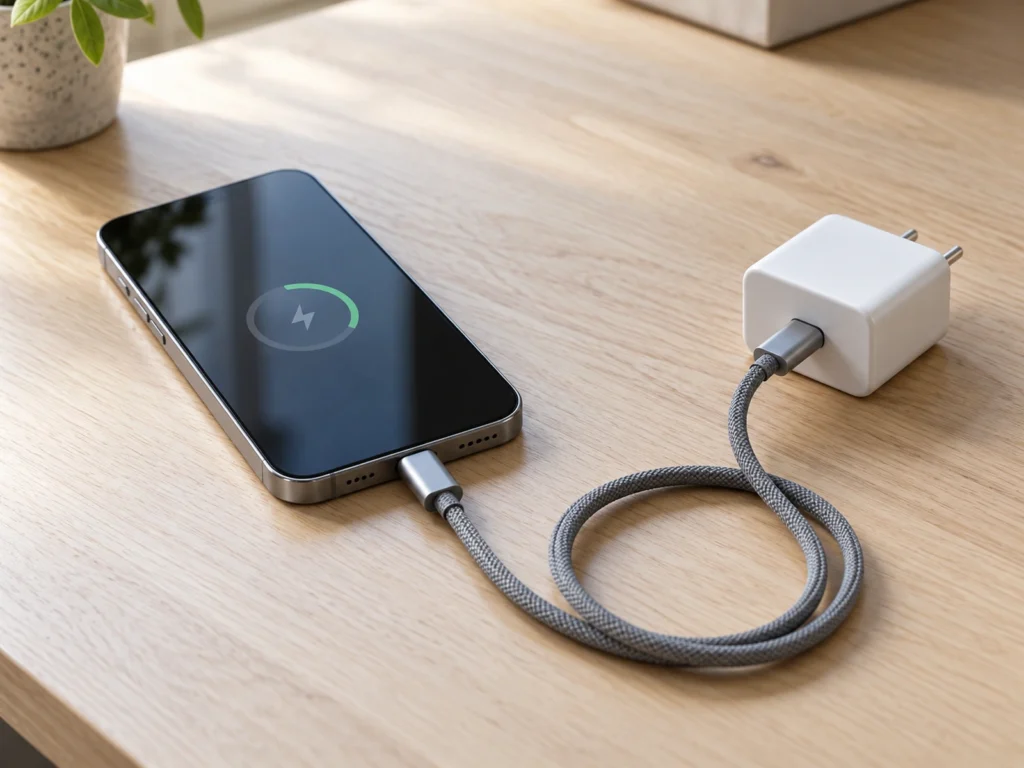
Samsung ties the 45 W rate to its own 45 W Super Fast Charger, which it describes as a USB Power Delivery 3.0 charger with PPS, a programmable mode that adjusts voltage and current as the battery fills. The cable counts too. Samsung’s charger guide says 45 W charging works only with the 45 W adapter and a 5 A cable, and its US support page lists a 3 A USB-C cable in the phone’s box, so the bundled cable alone won’t reach the top rate. Samsung’s own guidance says to use only Samsung-approved chargers and cables.
A USB Power Delivery charger without PPS, such as many laptop chargers, should still charge the phone, since Samsung’s spec sheet lists PD among the compatible standards. It will charge at a lower rate that Samsung doesn’t specify, so the 30-minute figure won’t apply. Third-party PPS chargers may do better, but Samsung doesn’t list or certify any, and we have not measured one. Samsung quotes its figure only for its own 45 W adapter, which is sold both with a 5 A cable and as an adapter alone, so check which version you buy.
Charging speed and data speed are different things
Power and data negotiate separately over the same USB-C connector, so a fast-charging port is not automatically a fast data port. Samsung’s FE spec sheet and launch release list the charging figures but not the USB data standard, so check it before relying on the cable for large video files. For comparison, our Samsung Galaxy S26 Ultra specifications record a USB 3.2 Gen 1 data port alongside 60 W wired charging.
Practical recommendations
Buy Samsung’s 45 W adapter with its 5 A cable if you charge in short bursts between meetings or before heading out. It is the only combination Samsung’s 30-minute figure refers to, and even then Samsung says charging speed depends on battery level and other factors.
Skip it if you mostly charge overnight. A slower Power Delivery adapter has all night to fill the phone, so the 30-minute figure doesn’t matter. Samsung doesn’t publish how warm the phone runs on each adapter, but it does say that continuous use or charging in extreme temperatures may speed up battery wear, and it recommends charging at room temperature.
Keep wireless charging for the desk. At up to 15 W it is a third of the wired peak, yet it suits a pad you drop the phone onto between tasks. Samsung notes that the phone and the charger can warm up while charging, and that a case or a metal object on the pad can make the phone overheat. Avoid damaged or uncertified adapters and cables, because Samsung warns that an incompatible charger or cable can cause injury or damage the phone.
Read the wattage on any box as a ceiling rather than a promise. Samsung’s 30-minute percentage is a useful guide, but its own documents print 65 and 69 percent for the same test, so treat it as approximate.