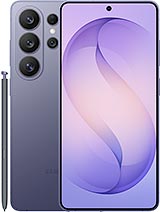
Samsung Galaxy S26 Ultra: specs and price
Category strengths
Why is Samsung Galaxy S26 Ultra better than the average?
- 128.57 MP more Main camera ?200 MP vs 71.43 MP (avg)
- 1,941,451 more AnTuTu benchmark ?3,934,365 vs 1,992,914 (avg)
- 5.43 GB more RAM ?12 GB vs 6.57 GB (avg)
- 116.67 MP more Ultrawide camera ?200 MP vs 83.33 MP (avg)
- 28.21 W more Wired charging ?60 W vs 31.79 W (avg)
- 2,314.29 p more Video resolution ?4,320 p vs 2,005.71 p (avg)
- 1,080 nits more Peak brightness ?2,600 nits vs 1,520 nits (avg)
- 105.14 GB more Internal storage ?256 GB vs 150.86 GB (avg)
- 1.84 GHz more CPU clock speed ?4.74 GHz vs 2.9 GHz (avg)
- 1,001.43 px more Resolution ?3,120 px vs 2,118.57 px (avg)
Why is Samsung Galaxy S26 Ultra not better than the average?
- No Expandable storage (microSD) ?
- No 3.5mm headphone jack ?
- 13.71 g more Weight ?214 g vs 200.29 g (avg)
- 207.14 mAh less Battery capacity ?5,000 mAh vs 5,207.14 mAh (avg)
- 0.51 mm more Thickness ?7.9 mm vs 7.39 mm (avg)
- 0.02 " less Screen size ?6.9 " vs 6.92 " (avg)
- 0.07 mm more Height ?163.6 mm vs 163.53 mm (avg)
Specifications
Quality bars are generated automatically against 13 other smartphones.
Design
A lighter device is more comfortable to hold and carry for long periods.
A thinner device is easier to hold and slip into a pocket.
A narrower phone is easier to use one-handed.
The vertical dimension of the device.
The primary frame and back materials of the device.
The device is protected against dust and submersion in water.
Reinforced glass (e.g. Gorilla Glass) resists scratches and cracks.
The device works with an active stylus pen.
The colour options the phone is sold in.
Display
A larger screen is better for media and multitasking.
The vertical pixel count; higher means a sharper image.
More pixels per inch produce crisper text and images.
A higher refresh rate produces smoother motion and scrolling.
How often the screen registers touches; higher feels more responsive.
Higher peak brightness is easier to read in direct sunlight.
A higher ratio means slimmer bezels and a more immersive front.
The underlying panel technology (e.g. LTPO AMOLED).
The proportional relationship between screen width and height.
OLED panels offer deeper blacks and better contrast than LCD.
Displays a wider range of colours and brightness in supported content.
Shows time and notifications while the screen is idle.
The reinforced glass protecting the screen (e.g. Gorilla Glass Victus 2).
The ratio between the brightest white and darkest black.
How many bits encode each colour; more means smoother gradients.
Supports Dolby Vision HDR for richer, scene-by-scene colour and contrast.
Higher PWM dimming frequency is easier on the eyes at low brightness.
Performance
The system-on-chip that powers the device.
The graphics processor handling games and visuals.
More RAM keeps more apps running smoothly at once.
More storage holds more apps, photos and files.
The storage standard (e.g. UFS 4.0); newer is faster.
A higher clock speed generally means faster processing.
More cores help with multitasking and demanding apps.
A smaller process is more power-efficient and runs cooler.
A synthetic score estimating overall performance.
Multi-core CPU benchmark score; higher is faster.
Single-core CPU benchmark score; higher is faster.
A GPU/graphics benchmark score; higher is faster.
The memory standard (e.g. LPDDR5X); newer is faster.
A higher graphics clock generally means faster gaming performance.
More last-level cache can improve processor efficiency.
Storage can be expanded with a memory card.
Battery
A larger battery generally lasts longer between charges.
Higher wattage charges the battery faster over a cable.
Higher wattage charges the battery faster wirelessly.
How long a full charge takes; lower is better.
The phone can wirelessly charge other devices.
Newer silicon-carbon cells pack more capacity into the same space.
The battery chemistry (e.g. Li-Po, Li-Ion).
The battery can be removed or replaced by the user.
Rated hours of voice calls on a charge.
Rated hours of idle standby on a charge.
Cameras
A higher megapixel count can capture more detail.
A lower f-number lets in more light for better low-light shots.
A larger sensor captures more light and detail.
The model of the main camera sensor (e.g. Samsung ISOCELL HP2).
Captures a wider field of view for landscapes and groups.
Enables closer, higher-quality zoom shots.
A higher resolution front camera improves selfies and video calls.
Magnifies subjects without losing detail.
OIS compensates for hand shake for sharper photos and steadier video.
The highest video resolution the device can record.
Captures ultra-high-resolution 8K footage.
A higher frame rate enables smoother slow-motion clips.
Saves unprocessed photos for more editing flexibility.
How many rear camera modules the phone has.
A lower f-number lets in more light for selfies.
The front camera can record 4K video.
Larger pixels capture more light for better low-light shots.
Connectivity
Connects to faster 5G mobile networks.
How many physical SIM cards the device accepts.
Supports a built-in digital SIM alongside or instead of a physical one.
Supports faster, more efficient Wi-Fi 6 networks.
Supports the latest, fastest Wi-Fi 7 standard.
A newer Bluetooth version improves range and efficiency.
Enables contactless payments and quick pairing.
A reversible, widely compatible charging and data port.
The USB data-transfer standard of the port; later is faster.
The satellite positioning systems the device can use; more means faster, more accurate location.
Enables precise spatial location for tracking and digital car keys.
Has a built-in FM radio receiver.
An IR blaster to control TVs and appliances.
Connect USB drives and accessories directly to the phone.
Radiofrequency energy absorbed by the head; lower is better.
Radiofrequency energy absorbed by the body; lower is better.
Audio
Two speakers deliver richer, more immersive sound.
Lets you use wired headphones without an adapter.
Adds spatial, three-dimensional audio in supported content.
Plays back high-resolution audio above CD quality.
Security & software
Unlock with a fingerprint sensor built into the screen.
Unlock the device by scanning your face.
How many years of OS upgrades the maker promises.
Send messages via satellite when off the mobile grid.
The software platform the device runs.
Sensors
Detects motion and orientation for auto-rotate and steps.
Senses rotation for gaming, photography and VR.
A magnetometer for navigation and maps.
Measures air pressure for altitude and weather.
Turns the screen off during calls when held to the ear.
Ratings & reviews
No reviews yet. Be the first to share your experience.
The bottom line
The Samsung Galaxy S26 Ultra earns a VS Score of 70, putting it among the very best of the 14 smartphones we compare here. It stands out for 128.57 MP more Main camera, 1,941,451 more AnTuTu benchmark and 5.43 GB more RAM. Just be aware of no Expandable storage (microSD) and no 3.5mm headphone jack before you buy. For most buyers it is an easy recommendation.
The VS Score is generated automatically from the weighted specifications above, measured against all other smartphones in our database. Treat it as a shortlisting guide — not a substitute for your own priorities.
Latest comparisons
vs vs
vs
 vs
vs
 vs
vs vsvs
vsvs vsvs
vsvs
 vs
vs vsvs
vsvs