Apple MacBook Air 15 M5 (2026): Specs, Price, Pros & Cons
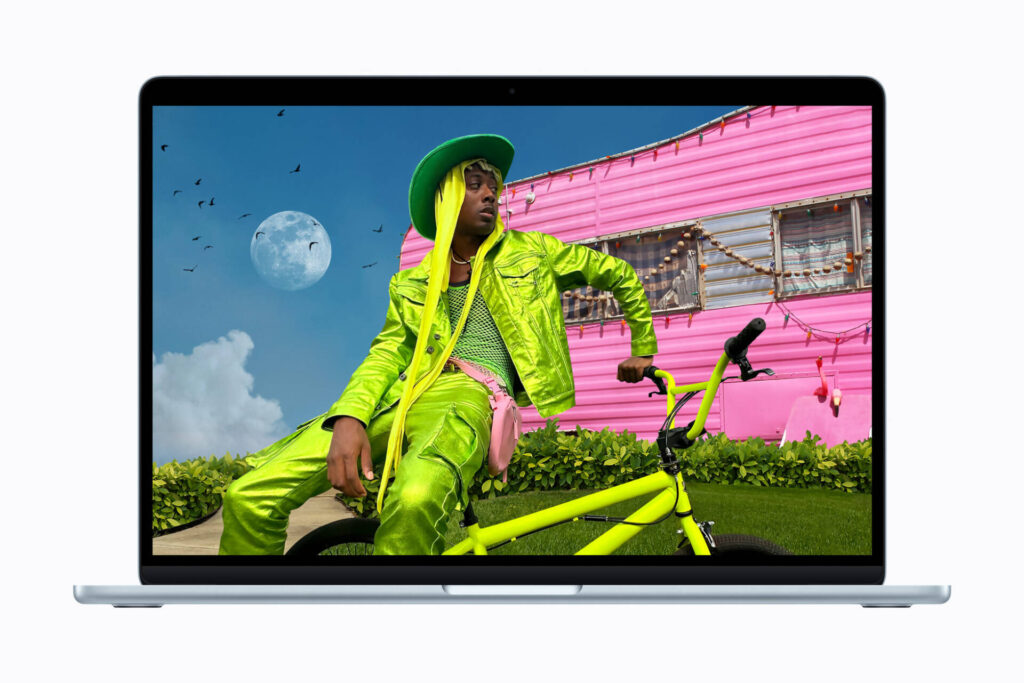
Apple gives the 15-inch MacBook Air with M5 a 66.5 watt-hour battery, about a quarter more than the 13-inch model carries. Apple still rates it at 18 hours of video streaming and 15 hours of web browsing, the same as the smaller Air. The bigger battery also has a bigger screen to light. The Liquid Retina panel grows to 15.3 inches, with 2880 by 1864 pixels at 500 nits.
Every configuration at this size has the full M5, with 10 CPU cores and 10 GPU cores. Each GPU core carries a Neural Accelerator, and Apple claims AI tasks run up to 4x faster than on the M4 Air. The base model pairs the chip with 16GB of unified memory and a 512GB SSD. Apple's two other ready-made versions add a 1TB drive, and the top one also adds memory. Factory options run to 32GB and 4TB.
Apple's laptops now run from the 13-inch MacBook Neo to the 16-inch MacBook Pro. This Air starts near thirteen hundred dollars. On October 27 the 14-inch MacBook Pro moved to the M6 chip, and its screen is smaller than this one. Among Mac laptops, only the 16-inch Pro has a display at least this large.
It weighs 3.3 pounds and measures 0.45 inch thick. Apple describes the fanless design as completely silent. Six speakers with force-cancelling woofers handle sound, and the 12MP Center Stage camera supports Desk View for showing a desk on a video call. Connections are MagSafe 3 for power, two Thunderbolt 4 ports and a headphone jack, and those ports drive up to two external displays at 6K. Touch ID is built into the backlit keyboard.
Category strengths
Where the Apple MacBook Air 15 M5 (2026) beats the median
- A much sharper webcam ?12 MP vs 2.1 MP (median)
- Much higher resolution ?1,864 px vs 1,200 px (median)
- A slimmer body ?11.5 mm vs 16.45 mm (median)
- A brighter display ?500 nits vs 400 nits (median)
- More microphones ?3 vs 2 (median)
- A slightly bigger screen ?15.3" (38.86 cm) vs 14" (35.56 cm) (median)
- A newer Bluetooth version ?6 vs 5.4 (median)
Where the Apple MacBook Air 15 M5 (2026) trails the median
- Much less storage ?512 GB vs 2,048 GB (median)
- Fewer USB-A ports ?0 vs 2 (median)
- No HDMI port ?
- No IR camera (Windows Hello) ?
- Slightly shorter battery life ?18 h vs 20 h (median)
- A slightly heavier build ?1.51 kg vs 1.49 kg (median)
How this VS Score was computed
Score 44: each known spec is measured against the median of all laptops (167 products), then weighted. 67% of the scoreable weight could be used. See how we score
| Specification | This product | Cohort median | Score weight | Points moved |
|---|---|---|---|---|
| Dedicated graphics | No | 28% of the class have it | 1 | −48.0 |
| Resolution | 1,864 — capped at the class’s upper range (1,800) | 1,200 | 1.5 | +37.5 |
| SSD storage | 512 — capped at the class’s lower range (1,024) | 2,048 | 1.5 | −37.5 |
| Fingerprint reader | Yes | 68% of the class have it | 0.5 | +25.0 |
| Webcam resolution | 12 — capped at the class’s upper range (5) | 2.1 | 0.5 | +25.0 |
| OLED display | No | 20% of the class have it | 0.5 | −24.0 |
| Touchscreen | No | 24% of the class have it | 0.5 | −24.0 |
| USB-A ports | 0 | 2 | 0.5 | −24.0 |
| HDMI port | No | 84% of the class have it | 0.5 | −24.0 |
| IR camera (Windows Hello) | No | 73% of the class have it | 0.5 | −24.0 |
| Thickness | 11.5 — capped at the class’s lower range (12) | 16.45 | 1 | +19.0 |
| Numeric keypad | No | 36% of the class have it | 0.3 | −14.4 |
| SD card reader | No | 38% of the class have it | 0.3 | −14.4 |
| Ethernet port | No | 34% of the class have it | 0.3 | −14.4 |
| Brightness | 500 | 400 | 1 | +13.0 |
| Battery life | 18 | 20 | 2.5 | −12.5 |
| Microphones | 3 | 2 | 0.3 | +7.5 |
| Screen size | 15.3 | 14 | 1 | +5.0 |
| Weight | 1.51 | 1.49 | 2 | −2.0 |
| Bluetooth version | 6 | 5.4 | 0.3 | +1.8 |
| CPU cores | 10 | 10 | 1 | +0.0 |
| RAM | 16 | 16 | 2 | +0.0 |
| Charging power | 70 | 70 | 0.5 | +0.0 |
| USB-C ports | 2 | 2 | 0.5 | +0.0 |
| Wi-Fi standard | Wi-Fi 7 | Wi-Fi 7 | 0.5 | +0.0 |
Not scored: Backlit keyboard (standard for the class (98% have it)); Convertible (2-in-1) (not applicable: only 14% of this class have it); Anti-glare display (unknown: not scored); Refresh rate (unknown: not scored); sRGB colour coverage (unknown: not scored); Upgradeable RAM (unknown: not scored); GPU memory (unknown: not scored); Geekbench score (unknown: not scored); Thunderbolt / USB4 (standard for the class (80% have it)); Battery capacity (capacity is a proxy; the rated battery life is scored instead); USB-C charging (standard for the class (100% have it)); Fast charging (standard for the class (100% have it)); Headphone jack (standard for the class (96% have it)); Wi-Fi 6E support (standard for the class (87% have it)); 1080p webcam (standard for the class (88% have it)); Stereo speakers (standard for the class (100% have it)).
Editor’s note
Dell asks around two thousand dollars for the base XPS 16 (2026). That model has a 1920 by 1200 screen and weighs 3.85 pounds. The Air shows more pixels, weighs less and costs hundreds of dollars less, which makes it the better value among big, thin laptops. Dell rates that LCD model at 31 hours of streaming. Its test and Apple's are run differently, so the two figures do not line up.
The 0.6 pound this Air adds over the 13-inch one is a fair trade for the extra screen, and the woofers are worth having for movies and calls without headphones. The MacBook Neo is no shortcut for someone who wants this screen, because Apple makes it in one smaller size only.
Of Apple's three ready-made versions, I'd skip the middle one. It adds storage and nothing else. The 24GB model is the better buy at this size, since a large screen invites more open windows. Memory is chosen when you order. The base model still covers a family computer that lives in a browser, Photos and Office.
A discounted 15-inch Air with M4 is worth a look only if its drive matches this model's base storage. Apple started the M4 model at half that. It also lacks the N1 chip and Wi-Fi 7.
The 14-inch MacBook Pro with M6 costs about as much as that Dell. Its SD card slot and its XDR display, which Apple rates at 1600 nits for HDR, suit a photographer who edits on the road. Spreadsheets, code and video calls get more from the extra screen area on the Air.
Specifications
Design
Display
Performance
Battery
Connectivity
Audio & camera
Software
Sources and verification
Where the specifications come from
- Official product pagesupport.apple.com
- Independent testingenergystar.gov
Verification
- First published
- Specifications last checked
- Sheet completeness
- 43 of 53 specifications verified; the rest show as Unknown and are never estimated or scored
- Page type
- Product specification page — Compiled from the manufacturer’s published specifications and the cited sources; this is not a hands-on test.
- Basis
- Research-based: specifications and editorial text were compiled from the documents listed here and the manufacturer’s published data. We have not tested this unit ourselves; where independent measurements are mentioned they belong to the linked publication.
Where to buy
Prices and availability may change. Check the retailer before buying. We may earn a commission on purchases.
Price history
Laptops with similar specs to the Apple MacBook Air 15 M5 (2026)
Ratings & reviews
No reviews yet. Be the first to share your experience.
The bottom line
The Apple MacBook Air 15 M5 (2026) earns a VS Score of 44, below the median of the 167 laptops it is measured against (a score of 50 is level with that median).
- Who it’s for
- People who keep two documents or a long editing timeline open side by side and want a 15-inch screen on a laptop with no fan, light enough to carry to class or the office.
- Who should look elsewhere
- Someone who carries a laptop all day on a commute would be better served by the 13-inch Air, which does the same work in a smaller, lighter case for less money.
- The trade-off that matters
- A projector at the office or a camera card at home means carrying a dongle, because the ports stop at Thunderbolt, MagSafe and a headphone jack.
- The main alternative
- Dell XPS 16 (2026): the pick for buyers who want an OLED touch screen, which Dell offers at 3.2K resolution
This page was created with the help of AI. How we work
Latest Laptops